What information should you collect before calling a customer back?
A callback-ready checklist for tradespeople: the job, location, timing, contact details, urgency, access, and what still needs checking.
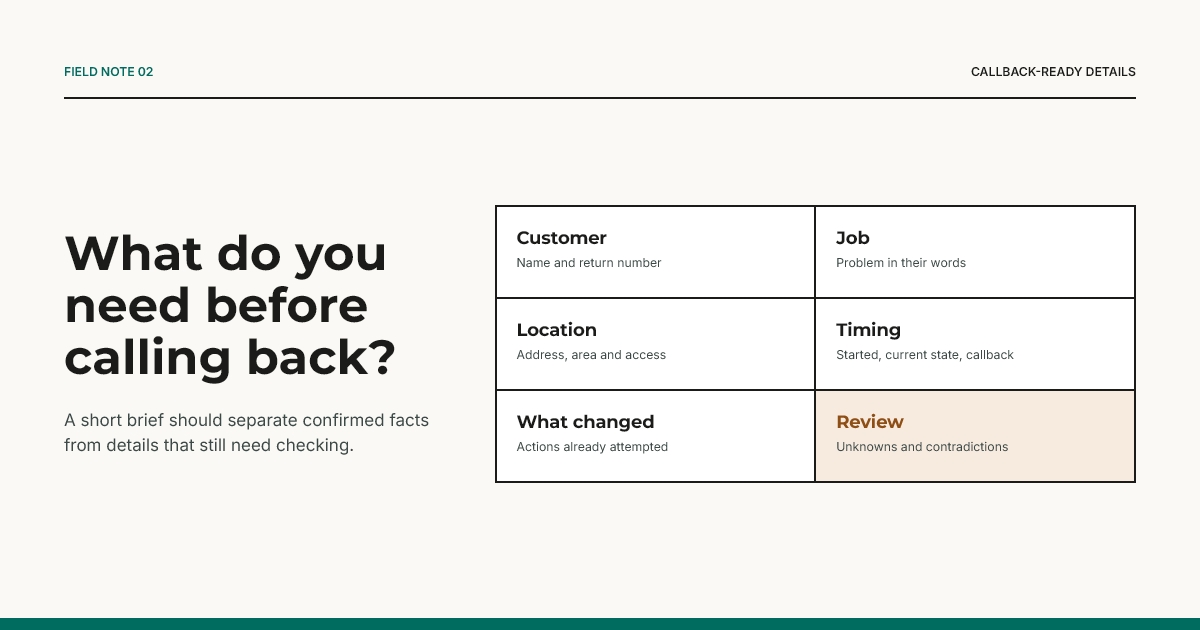
Before calling a new customer back, you need enough information to understand the work and decide the next step. Collect the caller's contact details, the problem in their words, the service location, timing, access constraints, and anything that remains uncertain.
You do not need a diagnosis or a finished quote. Those decisions belong after review.
Customer and callback details
Start with the details that let you continue the conversation:
- caller's name;
- telephone number;
- preferred callback time;
- whether somebody else will be at the property.
Read the telephone number back when it has been spoken rather than supplied by the phone system. A detailed job description is useless if the return number is wrong.
The problem in the caller's words
Capture what the caller can see, hear, or smell. Do not convert their description into a technical diagnosis during the first call.
"Water is coming through the kitchen ceiling" is useful evidence. "Failed upstairs compression fitting" is a conclusion that may be wrong.
The owner can ask technical follow-up questions during the callback. The first record should preserve the difference between what the caller observed and what somebody inferred.
Location and access
Record the full service address where possible, or at least the postcode and area when the caller does not have it to hand. Add access details that change the callback:
- flat, floor, or unit;
- parking or restricted access;
- tenant, landlord, or managing-agent involvement;
- locked gates or entry systems;
- whether the caller is currently at the property.
Do not bury the address inside a transcript. Put it in a predictable field that can be checked before travel is discussed.
Timing and urgency
Ask when the issue started, what is happening now, and when the caller is available. Keep urgency separate from diagnosis.
A caller can report active water, loss of power, no heating, or being locked out. The record should preserve that observation without promising an emergency response or telling the caller that the situation is safe.
If the caller describes immediate danger, follow the business's approved safety and escalation wording. A call-handling tool should not invent technical advice.
Work already attempted
Note anything the caller or another contractor has already done. This can prevent a repeated suggestion and gives the owner context for the callback.
Keep this section factual:
- appliance or supply switched off;
- stopcock or isolation point used;
- temporary containment in place;
- previous visit or repair mentioned;
- photos or documents available.
Do not turn those facts into confirmation that the problem is contained.
Unknowns and contradictions
A reliable job card makes gaps visible. Useful labels include "not provided," "caller unsure," and "needs owner review."
Two statements may also conflict. A caller might say the leak has stopped, then mention that water is still appearing downstairs. Keep both statements for review instead of choosing the more convenient one.
A compact callback-ready structure
Use this order when designing a form, note, or job card:
- Customer and return number.
- Problem as reported.
- Service address and access.
- Timing and observed urgency.
- Work already attempted.
- Preferred callback window.
- Unknowns, contradictions, and review flags.
The structure should be quick to scan on a phone. The full conversation can remain supporting evidence where retention is lawful and approved, but it should not replace the summary.
Where Max & Mia fits
Max & Mia is designed to gather known details through a natural conversation and ask only for information that is still missing. Its target outcome is at most one structured job card per call, ready for the owner to review.
The owner still decides whether the work fits, what it may cost, and when anybody can attend. The job card improves the callback; it does not make those commitments.
Put these seven fields into a reusable handover with the free Callback-Ready Job Card Builder. The on-site call-handling guide explains where that handover fits after an unanswered call.