How to handle customer calls when you are on site
A practical call-handling workflow for tradespeople who need useful callback details without stopping work or making promises too early.
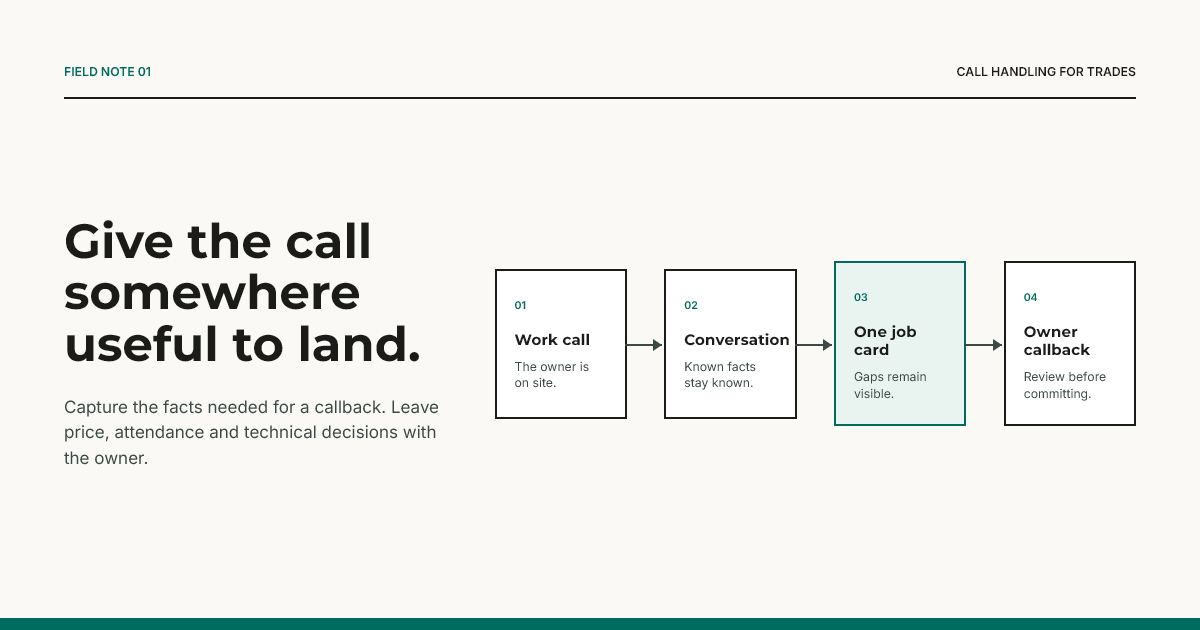
When you cannot answer a customer call, the next best outcome is not a longer voicemail. It is a short, accurate record of the job, the location, the caller's timing, and anything that needs careful follow-up.
That gives you enough context to decide who to call first. It also stops an answering process from making prices, arrival times, or service promises before you have reviewed the work.
Decide what the call should produce
A useful call-handling process should leave one callback record. It does not need to diagnose the fault or finish the sale.
For most first enquiries, capture:
- the caller's name and return number;
- what has happened, in the caller's own words;
- the address or area where the work is needed;
- whether there is an immediate safety concern;
- when the caller can speak or receive a visit;
- any detail the caller could not confirm.
The final point matters. An unknown access time should remain unknown. Guessing turns a clean handover into a promise the business did not make.
Choose a route you can test and reverse
Start with a dedicated work number or a forwarding setup you understand. Place test calls from an external phone, check what the caller hears, and confirm where the captured details appear.
Write down how to turn the routing off before relying on it. A setup is not under control if only the person who installed it knows how to disconnect it.
Carrier menus and forwarding codes vary. Treat any generic setup guide as preparation, then confirm the exact steps with your provider.
Keep the conversation natural
Callers often give several useful details in one sentence:
"It is the kitchen tap at 14 West Street. It started leaking this morning, and I will be home after four."
A rigid questionnaire may ask for the address or timing again because those questions come later in its script. A better process recognises what the caller has already said and asks only for the missing details.
Natural does not mean unbounded. The call still needs clear limits. It should not quote a price, guarantee attendance, confirm an unsupported service, or offer technical advice that belongs with a qualified tradesperson.
Make failure understandable
Silence, a dropped connection, or an unavailable service should not trap the caller in a loop. Decide what happens when the process cannot continue:
- Retry a missed answer once where that is useful.
- Keep details the caller already confirmed.
- Close honestly if the conversation cannot continue.
- Mark the record for review rather than presenting uncertain details as complete.
The owner should be able to tell the difference between a complete enquiry, a partial call, and a failed call.
Review before you commit
Read the captured record before calling back. Check the name, location, problem, timing, and any warning or uncertainty. Then make the commercial and practical decisions yourself.
This is where a structured job card is more useful than a transcript alone. A transcript preserves the exchange, but a job card puts the details needed for the next action in a predictable place.
How Max & Mia approaches the handover
Max & Mia provides an assigned number for UK trade and home-service businesses. Customers can call it directly, or the owner can forward selected or all calls from an existing work number. Its target flow uses the business's published context during a natural conversation, creates at most one structured job card for the call, and leaves that card for the owner to review.
The current product scope does not include autonomous booking, quotes, payments, diagnosis, or guaranteed arrival times. Those boundaries are deliberate: the assistant gathers callback context while the owner keeps control of commitments.
The practical test is simple. After the call, can you see what the customer needs, where the work is, when to respond, and what still needs checking? If the answer is yes, the call-handling process has done its job.
Define the handover your business needs with the free job-card builder, using the callback-ready details checklist when a field needs clarification.