AI receptionist or voicemail: what changes for the caller?
Compare voicemail with a bounded AI call-handling flow by looking at the details captured, the promises avoided, and the handover the owner receives.
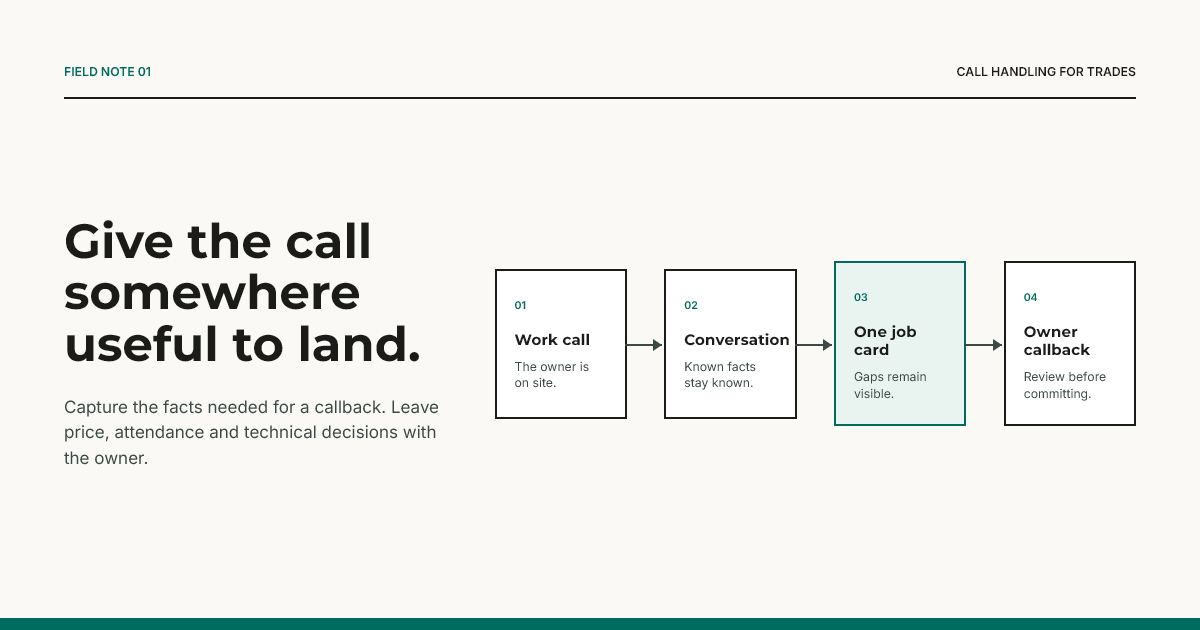
Voicemail records whatever the caller chooses to say. A bounded AI receptionist can ask for missing details, confirm what it heard, and produce a structured handover. The useful comparison is not voice recording versus synthetic voice. It is loose message versus reviewable callback context.
What the caller experiences
A voicemail greeting gives one instruction, then waits. A caller reporting a leaking kitchen tap may leave a name and problem but forget the address or return number. The owner has to call back to fill the gaps.
A conversational service can recognise details already supplied and ask only for what is missing. If the caller gave the address and timing in the opening sentence, repeating those questions makes the call longer without improving the handover.
What reaches the owner
Voicemail leaves audio. A useful call-handling flow leaves one record with the customer, reported issue, location, timing, and unknowns in predictable places. The owner can scan that record before deciding who to call first.
Structure does not make every field true. A caller may be unsure which flat contains the stopcock or whether access is available. Those details should remain marked for review.
Where both approaches need boundaries
Neither voicemail nor an AI receptionist should make commercial or technical decisions for the tradesperson. Max & Mia's MVP excludes quotes, payments, autonomous booking, diagnosis, and guaranteed arrival times. The owner reviews fit, price, timing, and attendance.
Failure also needs a visible outcome. Silence, interruption, or a dropped connection should lead to a bounded retry or an honest close, not a complete-looking record built from partial information.
How to choose
Use voicemail if hearing the caller's message is enough and you are prepared to collect missing details later. Test a conversational service when the missing details are the main source of callback friction.
Run both through the same cases: a complete enquiry, a caller who interrupts, an uncertain address, an unsupported request, silence, and a dropped call. Compare the handover, not the novelty of the voice.
The AI receptionist test guide gives those cases a repeatable shape. Use the job-card builder to define the record you expect after either route.